Arie van 't Riet Dutch, b. 1947

Arie van 't Riet (1947, Aarlanderveen) grew up in the Green Heart of South Holland, which formed the basis for his fascination with biology and nature. Before entering the art world, Arie pursued a long and succesful scientific career. He studied radiation physics at Delft University of Technology and later obtained a PhD in physics (brachytherapy) at Utrecht University. Van 't Riet worked as a clinical physicist for over 30 years, including at the RISO Radiotherapy Institute. In that role, he was involved in the technical and safe application of radiation in hospitals.
His artistic career began around 2007/2008. It started by chance when a colleague asked him to take an X-ray of a painting, something he had never done before. This sparked his curiosity to also capture natural objects, such as flowers and deceased animals. Since then, he has continued to experiment and has developed into a globally acclaimed artist:.
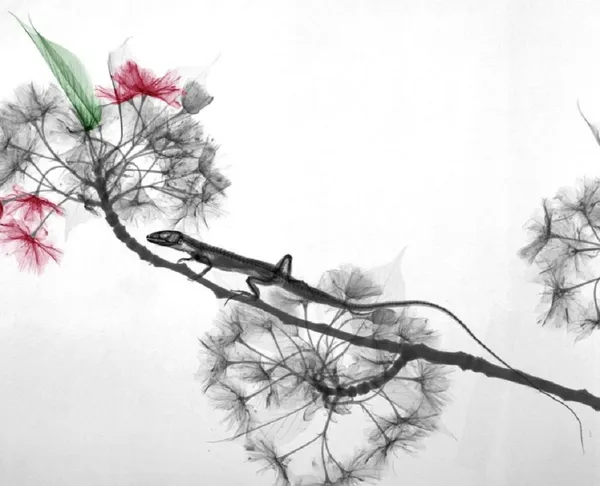
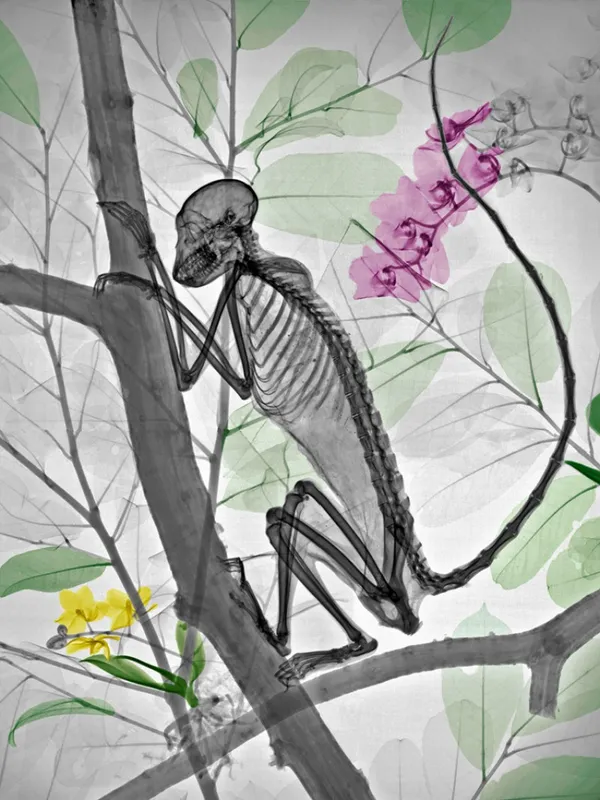
Arie van “t Riet's art, which he himself calls Bioramas, is a unique combination of science and aesthetics. In terms of content, he reveals the 'invisible world” of nature: the delicate internal structures that normally remain hidden beneath the skin or inside the flower. Technically, his art form is highly complex, but visually very accessible. The different radiation levels make his work technically challenging: it is difficult to capture objects with different densities correctly on the plate in one go. Low energy is needed for petals, while high energy is required for bones. Van “t Riet has to balance the exposure times and energy settings precisely to make both structures visible at the same time. He works with traditional analogue X-ray film (often 33x41 cm), so the image has to be right in a single shot, as he cannot digitally 'stack” layers afterwards to build up the image.
Because Arie does not want to expose living creatures to radiation, he only uses dead animals (e.g. roadkill). In terms of composition, it is a creative process to arrange the animals in such a way that they look lively and natural in their surroundings. After digitising, he colours parts of the image manually to focus on specific details.
Aries' bioramas have been exhibited at venues including the Natural History Museum Rotterdam. His images have been included in the Science Photo Library, which supplies images to scientific publications worldwide. He had publications in The Guardian, The Telegraph and others, and he has given his own TEDx talk. His photography is also compiled in the award-winning book Inside In, in which his X-rays are used to teach children about nature.
-
 Barn Owl
 -
Bouquet of Eleven Tulips
-
Butterbur
-
Chamaerops Humilis Azalea Butterfly
-
Chameleon Begonia
-
Chicken
-
Eel
-
Field of Tulips
-
Franse Tulpen
-
Frog Python Water Lily Sarracenia
-
Frog Water Lily
-
Helianthus Tuberose Butterflies
-
Heron
-
Iguana Angels Trumpet (Brugmansia)
-
Klaprozen
-
Lizard Azalea Fatsia Japonica
-
Lizard Poppy
-
Lizard Prunus
-
Moorhen Iris
-
Needlefish
-
Orchids
-
Parrot Tulips
-
Roach Waterlily
-
Rosa Venezuela
-
Sandersonia Dragonfly Butterfly
-
Savannah Monitor Python Medinilla
-
Snails Hedera
-
Squirrel Monkey
-
Strelitzia Chameleon
-
Toads Euphorbia
-
Tulpen boeket
-
Turdus Merula Magnolia
-
Turtles Trachycarpus Azalea
-
X-Ray Fotoblok